

Wireless networks are only as reliable as the design behind them. Prior to deploying access points in any environment, it is essential to validate how radio frequency (RF) signals will propagate within the facility.
Wireless networks are only as reliable as the design behind them. Prior to deploying access points in any environment, it is essential to validate how radio frequency (RF) signals will propagate within the facility, how various building materials will impact signal attenuation, and how potential sources of interference may affect overall performance. A comprehensive pre-deployment wireless site survey provides this assurance, ensuring that coverage, capacity, and seamless roaming are engineered correctly from the outset.
At a multi-floor facility in Virginia, we conducted an in-depth pre-deployment survey utilizing Ekahau predictive modeling, AP-on-a-stick validation, and spectrum analysis. This methodology enabled us to develop a precise access point placement strategy that minimizes co-channel interference, ensures consistent coverage at -67 dBm or better, and provides a scalable infrastructure designed to support future wireless technology upgrades.
The Virginia facility is a large, multi-floor site that combines both office spaces and operational areas. This mix of environments presents unique challenges for wireless design. Open office layouts require high-density coverage to support a large number of simultaneous users, while warehouse-like areas demand stronger signal penetration through shelving, machinery, and structural materials.
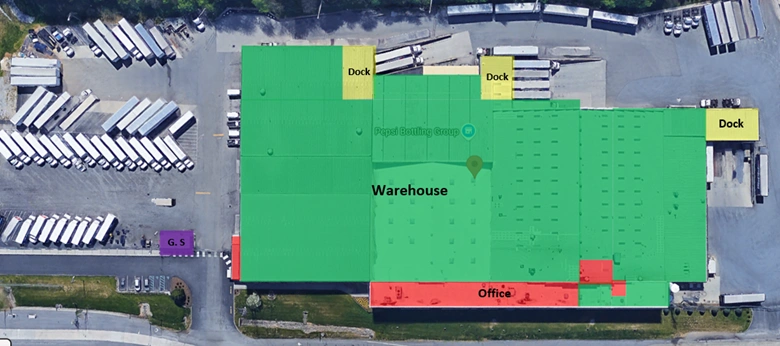
The survey objectives were clear:
- Ensure reliable signal coverage throughout the building.
- Design for seamless roaming so staff could move without losing connection.
- Optimize for throughput, supporting voice, video, and data with low latency.
Challenges and Constraints
Every facility presents its own obstacles, and this project was no exception. The building featured reinforced concrete walls and steel supports, both of which are notorious for attenuating wireless signals. These materials required careful modeling to avoid signal degradation.
Additionally, the site housed equipment that could contribute to RF interference. Industrial machinery, legacy wireless devices, and even external networks created a noisy spectrum that needed to be accounted for. To add to the complexity, the client required that installation be completed on a tight timeline, leaving little room for error. The survey had to deliver a design that would not only work flawlessly but also streamline the deployment process.
Methodology
To ensure accuracy, our engineers took a hybrid approach, combining predictive software modeling with on-site testing.
The process began by importing detailed floor plans into Ekahau Pro, a leading wireless design tool. Each wall, door, and partition was assigned an attenuation value to simulate how signals would propagate. This predictive model allowed engineers to test different AP placements virtually, saving time and effort during the physical deployment.
Next, the team performed AP-on-a-stick testing at key points throughout the building. This involved mounting temporary access points and measuring live RF data with the Ekahau Sidekick. These real-world measurements validated the predictive model, ensuring that theoretical coverage translated into actual performance.
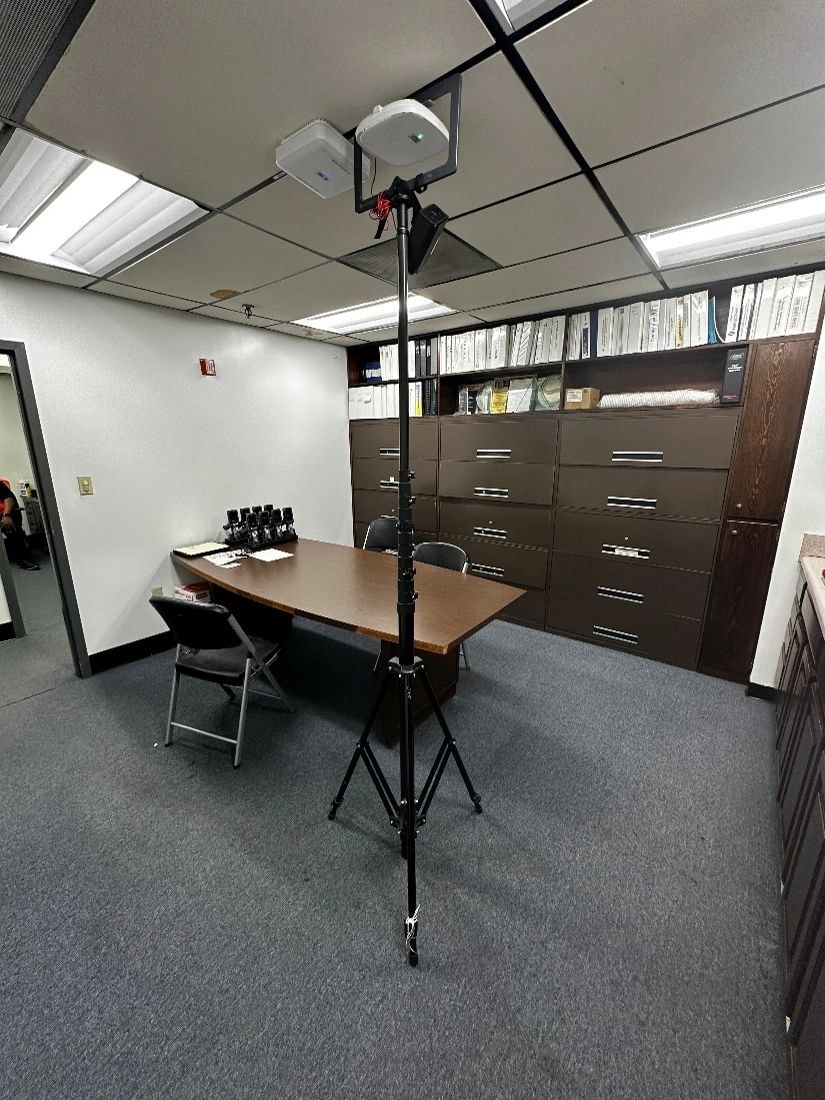
Finally, a spectrum analysis was conducted to identify sources of interference. By capturing data across both the 2.4 GHz and 5 GHz bands, the team confirmed channel utilization and noise levels, which informed channel and power planning.
Key Findings
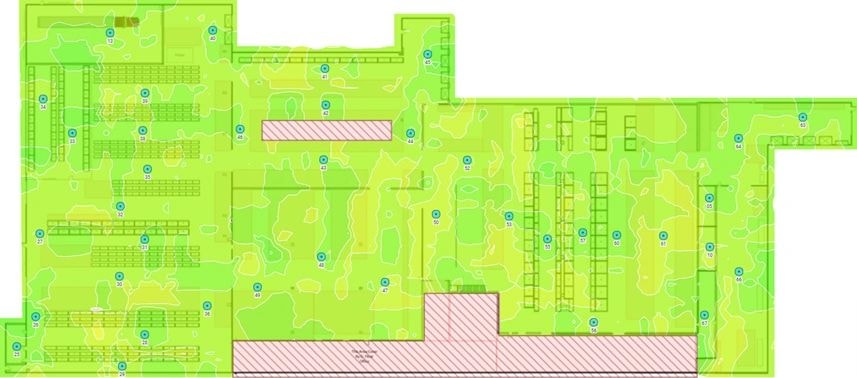
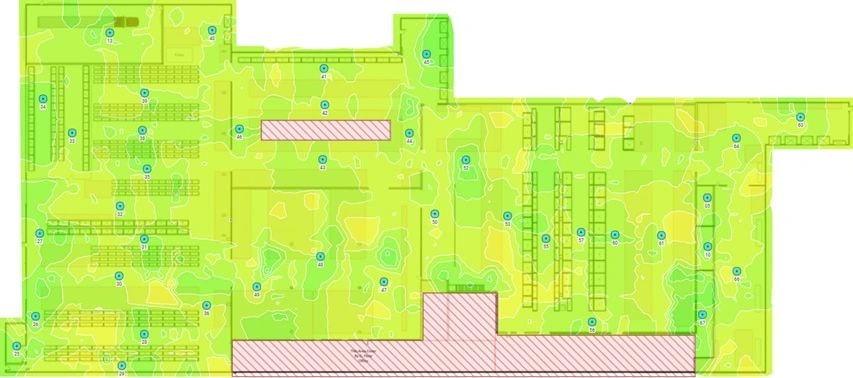
The results of the survey provided a clear roadmap for deployment. Predictive modeling combined with on-site testing showed multiple access points would provide complete coverage across the facility. The network design achieved 99.1 percent area coverage at -67 dBm or better, meeting the project's stringent performance requirements.
The analysis also revealed minor co-channel interference in the 2.4 GHz band. While this is a common occurrence in dense environments, the issue was addressed through band steering, encouraging client devices to connect to the less congested 5 GHz spectrum. This not only reduced interference but also improved overall throughput.
Projected throughput levels exceeded 400 Mbps on average per zone, ensuring the network could support bandwidth-intensive applications like video conferencing, VoIP, and cloud services.
Signal Strengths
Recommendations
Based on the findings, the final design called for the deployment of Wi-Fi 6 access points equipped with dual-band antennas. These APs were strategically placed to balance coverage and capacity while maintaining a consistent roaming experience.
Channel and power levels were carefully tuned to minimize overlap and maximize performance. Band steering was recommended as a standard configuration, ensuring that devices made the best use of available spectrum. To future-proof the design, engineers also recommended provisioning sufficient backhaul capacity and ensuring the infrastructure could seamlessly support next-generation wireless standards when the client decides to adopt them.
Expected Impact
The survey results gave the client confidence that their network installation would deliver on day one. By addressing coverage gaps and interference in advance, the design virtually eliminated the risk of dead zones.
The precise AP placement plan will also reduce installation time, as installers can follow a tested blueprint without second-guessing locations. End users will benefit from seamless roaming and faster speeds, improving productivity across the board. Most importantly, the facility now has a future-ready network design, capable of supporting the latest devices and emerging wireless standards.
Best Practices and Lessons Learned
This project underscored the importance of conducting a thorough pre-deployment survey. Attempting to install Wi-Fi blindly can lead to wasted time, additional costs, and frustrated users. Instead, predictive design combined with live testing creates a reliable roadmap for success.
Other organisations planning a network upgrade can learn from this project by:
- Always validating predictive models with on-site data.
- Accounting for building materials and interference sources in the design.
- Planning for device density and future growth, not just current needs.
- Leveraging modern survey tools like Ekahau Pro and Sidekick to eliminate guesswork.
In Virginia, wireless pre-deployment survey delivered the insights needed to design a Wi-Fi network with 99 percent coverage, robust throughput, and zero dead zones. By combining predictive modeling, AP-on-a-stick testing, and spectrum analysis, the project produced a reliable, future-ready design that will serve the facility for years to come.
Please book a free consultation appointment by visiting our website